

Missing Tooth Replacement Options: Implant, Bridge, or Partial Denture?
Compare common ways to replace a missing tooth, including dental implants, fixed bridges, and removable partial dentures, and learn what dentists consider when recommending an option.
Written By Escrito Por
Gateway Dental
Reviewed By Revisado Por
Gateway Dental Team

If you are missing a permanent tooth, there is usually more than one way to replace it. The difficult part is not simply choosing the option that sounds most modern or most affordable. It is deciding which treatment fits your mouth, your health, the location of the missing tooth, and your long-term goals.
For many adults, the discussion includes three common approaches:
- A dental implant supporting a crown
- A fixed dental bridge supported by neighboring teeth
- A removable partial denture
If several teeth are missing, the plan may also include implant-supported bridges, larger partial dentures, or other combinations of restorative treatment.
There is no universal “best” tooth replacement for every patient. A healthy neighboring tooth, the amount of available bone, gum health, smoking history, the number and position of missing teeth, treatment timing, maintenance needs, and budget can all change the recommendation.
At Gateway Dental, tooth replacement planning begins with an examination and a review of the structures that will support the restoration. This guide explains how implants, bridges, and partial dentures differ and what dentists evaluate before recommending one option over another.
Why replace a missing tooth?
A missing tooth can affect more than appearance.
Depending on which tooth is absent and how your bite is organized, tooth loss may change chewing, speech, comfort, or the way forces are distributed across the remaining teeth. The U.S. Food and Drug Administration also notes that tooth loss can be associated with changes in chewing patterns and bone loss in the area where the tooth root is no longer present.
That does not mean every missing tooth must always be replaced. Wisdom teeth, for example, generally are not replaced after removal. In other situations, a dentist may determine that maintaining the space is reasonable based on the bite and overall treatment plan.
For many functional permanent teeth, however, replacement is worth discussing because the space may affect how the mouth works over time.
If your tooth was recently removed, our guide to tooth extraction recovery explains what happens during early healing and why replacement planning may be part of the follow-up conversation.
What are the main options for replacing a missing tooth?
The three most common categories patients hear about are implants, bridges, and removable partial dentures.
Each replaces the visible tooth, but they do not obtain support in the same way.
| Option | Fixed or removable? | Main source of support | Surgery usually involved? | Common reason it may be considered |
|---|---|---|---|---|
| Dental implant with crown | Fixed | Implant placed in jawbone | Yes | Replacing one tooth without using neighboring teeth as the main support |
| Fixed dental bridge | Fixed | Neighboring teeth or implants | Usually not for a conventional tooth-supported bridge | Replacing a gap with a restoration attached to supporting teeth |
| Removable partial denture | Removable | Remaining teeth, gums, and appliance framework/base | Usually no | Replacing one or several teeth with a removable appliance |
The table is only a starting point. A dentist still needs to determine whether the supporting teeth, gums, bone, and bite are suitable for the option being considered.
Option 1: Dental implant and crown
A dental implant is a medical device placed into the jawbone to act as support for an artificial tooth. After the implant is placed and the area heals, a restoration such as a crown can be connected to it.
The FDA explains that implants can support crowns, bridges, or dentures and may help restore chewing, appearance, and stability in the area of a missing tooth.
Why someone might consider an implant
For a single missing tooth, an implant can replace the missing root and support a crown without relying on adjacent natural teeth in the same way as a conventional bridge.
An implant may be attractive when:
- The teeth next to the space are healthy
- There is sufficient bone for implant placement, or the area can be predictably prepared for it
- Gum health is stable
- The patient is comfortable with a surgical procedure and healing period
- A fixed replacement is preferred
- The patient can maintain excellent daily cleaning and regular professional follow-up
Gateway Dental’s implant dentistry page explains the broader role implants can play in replacing one or multiple missing teeth.
What are the limitations of implants?
Implants are not automatically appropriate for everyone.
The FDA notes that overall health, smoking, healing capacity, infection, bone and gum conditions, and oral hygiene can affect implant treatment and long-term success. Implant placement also involves surgery, and the healing process may take several months or longer before the final restoration is completed in some cases.
Implants can also develop complications. If you already have an implant and are concerned about looseness, pain, swelling, or bleeding around it, see our guide to dental implant warning signs.
Option 2: Fixed dental bridge
A fixed dental bridge replaces one or more missing teeth by spanning the space with artificial teeth connected to supporting structures.
The American Dental Association’s MouthHealthy resource explains that a conventional fixed bridge is attached to surrounding teeth for support. Unlike a removable appliance, a fixed bridge is removed only by a dentist.
Why someone might consider a bridge
A bridge may be considered when:
- There are suitable supporting teeth next to the space
- The patient prefers a fixed restoration
- Implant surgery is not desired or not appropriate
- The neighboring teeth already need crowns or significant restorative treatment
- The location and bite allow a predictable bridge design
A bridge can restore the missing tooth without placing an implant in the jaw. Treatment timing may also differ from implant treatment because a conventional tooth-supported bridge does not require implant integration with bone.
What are the tradeoffs of a bridge?
A bridge depends heavily on the health and strength of its supporting teeth.
Those teeth may need to be reshaped to receive crowns as part of a conventional bridge. That can be a reasonable tradeoff when the supporting teeth already need extensive restoration, but it may be less appealing when they are completely healthy and untouched.
The area under and around a bridge also requires careful cleaning. Plaque and decay can develop around the supporting teeth, so daily hygiene and regular dental follow-up remain important.
Gateway Dental’s restorative dentistry services focus on evaluating damaged, missing, or previously restored teeth and selecting treatment based on the condition of the remaining tooth structure and supporting tissues.
Option 3: Removable partial denture
A removable partial denture replaces one or more missing teeth while some natural teeth remain.
Unlike a fixed bridge or implant crown, the appliance can be removed by the patient. Depending on its design, it may use a framework, clasps, attachments, the gums, and remaining teeth for support and stability.
Why someone might consider a partial denture
A partial denture may be useful when:
- Several teeth are missing in different parts of the mouth
- A removable option is acceptable
- Implant surgery is not desired or appropriate
- The patient needs a lower-complexity way to replace multiple teeth
- The remaining teeth can support a properly designed appliance
For some patients, a partial denture may be a long-term solution. For others, it may be part of a staged plan while they consider implants or other restorative treatment later.
Our guide to full dentures vs. partial dentures explains how dentists distinguish between these removable options when some or all natural teeth are missing.
What are the tradeoffs of a partial denture?
Because a partial is removable, it does not feel or function exactly like a fixed tooth replacement.
Patients need to learn how to insert, remove, and clean the appliance properly. Fit may also change over time as the gums, bone, and remaining teeth change.
The ADA recommends ongoing professional evaluation because removable dentures that become loose or uncomfortable may need adjustment rather than do-it-yourself repair.
Gateway Dental’s dentures and partials page provides more information about removable tooth replacement options.
Implant vs. bridge: how do dentists compare them?
For one missing tooth, patients often ask whether an implant or bridge is better.
The answer depends on the structures around the space.
Condition of the neighboring teeth
If both neighboring teeth are healthy and have never needed large restorations, preserving them may favor discussion of an implant because the implant provides its own support in the missing-tooth site.
If the neighboring teeth already need crowns because of large fillings, fractures, decay, or other structural problems, incorporating them into a bridge may make more sense in some treatment plans.
Bone and gum health
An implant depends on adequate bone and healthy surrounding tissues. A bridge depends on strong supporting teeth and healthy periodontal support around those teeth.
Neither option should be selected without evaluating gum health, bone levels, bite forces, and hygiene.
Surgery and healing
Implant placement is surgical and may require a healing period before the final crown is placed. A conventional bridge usually avoids implant surgery but requires preparation of the supporting teeth.
Maintenance
Both require long-term care.
Implants need meticulous cleaning around the implant crown and gumline. Bridges require cleaning around the supporting teeth and beneath the replacement tooth. Neither should be considered “maintenance free.”
Implant vs. partial denture: what is the difference?
The biggest practical difference is that an implant-supported crown is fixed, while a conventional partial denture is removable.
An implant replaces a specific missing-tooth root with a device anchored in bone. A partial denture can replace several teeth at once and obtains support from the remaining oral structures.
A partial may make more sense when several teeth are missing, surgery is not appropriate, or the patient prefers a removable approach. An implant may be attractive when replacing a single tooth with a fixed restoration and the anatomy and health conditions are favorable.
There are also hybrid approaches. Implants can support bridges or help stabilize some removable prostheses, so the decision is not always limited to one category.
Our broader dental implants guide explains implant-supported crowns, bridges, and dentures in more detail.
What if several teeth are missing?
When multiple teeth are absent, treatment planning becomes more complex because the dentist is rebuilding a larger part of the bite.
Possible approaches can include:
- A removable partial denture
- Multiple individual implants
- An implant-supported bridge
- A combination of natural teeth and prosthetic support
- Full dentures when all teeth in an arch are missing or cannot be maintained
The right plan depends on how many teeth remain, where they are located, whether those teeth are healthy enough to keep, the amount of supporting bone, the patient’s medical history, and the desired balance between fixed and removable treatment.
This is one reason a comparison based only on price can be misleading. Two patients who are both “missing three teeth” may need very different treatment because the location and condition of the remaining teeth are different.
What if the missing tooth has been gone for years?
Replacement may still be possible, but the treatment plan can be different from one made immediately after tooth loss.
After a tooth is lost, the bone and surrounding tissues can change. Nearby teeth may also move or tilt into the space, and the opposing tooth can change position in some cases.
A dentist may therefore evaluate:
- Available space for a replacement tooth
- Bone volume and shape
- Gum contours
- Position of neighboring and opposing teeth
- Bite relationships
- Whether orthodontic or preparatory treatment is needed before the final restoration
For implant planning, current imaging may be needed to evaluate the bone and nearby anatomy. Our guide Are Dental X-Rays Safe? explains why dental imaging should be selected according to the clinical question rather than taken on a fixed schedule.
How soon after an extraction can a tooth be replaced?
Timing depends on the reason for the extraction, infection, bone and gum condition, the replacement method, and the patient’s healing response.
Some treatment plans begin before the tooth is removed so the dentist can coordinate the extraction with temporary or final replacement options. In other cases, healing is needed before the definitive restoration can be completed.
Implants can require several months of healing after placement before the final prosthetic phase. Bridges and removable appliances follow different timelines.
If a tooth is currently painful or damaged but has not yet been removed, Gateway Dental’s tooth extraction services and our guide to root canal vs. tooth extraction explain why dentists first determine whether the natural tooth can be predictably saved.
Which option is the least expensive?
There is no reliable universal price ranking that applies to every treatment plan.
A removable partial denture often involves a different level of surgical and laboratory complexity than an implant, but the total cost of any option depends on factors such as:
- Number of teeth being replaced
- Need for extraction or bone grafting
- Condition of supporting teeth
- Materials selected
- Additional restorative work
- Insurance benefits
- Future maintenance, adjustment, repair, or replacement
The lowest initial fee is not always the same as the lowest long-term cost, and the most expensive option is not automatically the best choice.
Gateway Dental’s insurance information and financing information can help patients understand how benefits and payment options may fit into a treatment plan after the clinical recommendation is established.
What does a dentist evaluate before recommending a replacement?
A tooth replacement should be designed around the patient, not around a product.
A comprehensive evaluation may include:
- Which tooth or teeth are missing
- Why the tooth was lost
- Health of the remaining teeth
- Presence of cavities or cracked teeth
- Gum and periodontal health
- Bone quantity and quality in the missing-tooth area
- Bite forces and tooth position
- Medical conditions that can affect surgery or healing
- Smoking or tobacco use
- Ability to clean the proposed restoration
- Appearance and speech priorities
- Preference for fixed vs. removable treatment
- Treatment timing
- Insurance and financial considerations
Radiographs or other imaging may be recommended when they are expected to change diagnosis or treatment planning.
If you are new to Gateway Dental, our first-visit information explains what records and dental history can be useful during an initial evaluation.
Is one tooth replacement option more permanent than the others?
No dental restoration should be described as permanent in the sense of never needing maintenance, repair, or replacement.
Implants can function for many years, but the implant, surrounding tissues, and attached crown still require monitoring. Bridges can also last for years, but their supporting teeth remain vulnerable to decay, fracture, or periodontal disease. Partial dentures can require adjustment, relining, repair, or replacement as the mouth changes.
Long-term success depends heavily on:
- Daily plaque control
- Cleaning around and under the restoration
- Regular dental examinations
- Managing gum disease and cavities
- Avoiding tobacco
- Addressing grinding or excessive bite forces when relevant
- Repairing problems before they become larger
A good treatment plan should include both how the tooth will be replaced and how the replacement will be maintained.
Can you leave a missing tooth alone?
Sometimes, yes—but that decision should be deliberate rather than accidental.
A dentist may decide that a space does not require replacement when the missing tooth is not important to function, the bite is stable, and leaving the space is unlikely to create meaningful problems.
In other cases, leaving the space may contribute to changes in chewing, tooth position, appearance, or treatment complexity later.
The safest approach is to have the space evaluated and understand the tradeoffs before deciding to do nothing.
What is the best option for replacing a missing tooth?
The best option is the one that provides a predictable result for your specific anatomy, health, bite, maintenance ability, and goals.
For one patient, that may be an implant and crown. For another, a fixed bridge may be more appropriate because the neighboring teeth already require restoration. For someone missing several teeth, a partial denture or implant-supported solution may make more sense.
The goal is not to choose the most sophisticated treatment. It is to choose the treatment that fits the clinical situation and that you can maintain successfully over time.
Tooth replacement planning at Gateway Dental
If you are missing a tooth in Miami, Hialeah, Coral Way, or another Miami-Dade community, Gateway Dental can evaluate the space, remaining teeth, gums, bone, and bite and discuss appropriate replacement options.
Depending on your needs, that discussion may connect with implant dentistry, dentures and partials, restorative dentistry, or treatment needed before replacement can begin.
You can review our Gateway Dental locations to choose the office that is most convenient for your evaluation.
The most useful first question is not simply, “Which replacement is best?” It is: “Which option is most predictable for my mouth, and what will I need to do to keep it healthy?”
Continue learning about your dental care. Siga aprendiendo sobre su cuidado dental.
Explore more Gateway Dental articles related to patient education, dental visits, and treatment planning. Explore más artículos de Gateway Dental relacionados con educación del paciente, visitas dentales y planificación de tratamiento.

Restorative Dentistry
Getting a Dental Bridge: Planning, Temporary Teeth, and Caring for the Result
Wondering what happens when you get a dental bridge? Understand the evaluation, preparation, temporary options, fit checks, and long-term cleaning.

Restorative Dentistry
How Long Does a Dental Bridge Last? Care, Cleaning, and Warning Signs
Learn why dental bridge lifespan varies, how daily cleaning and supporting-tooth health matter, and which changes should be checked by a dentist.
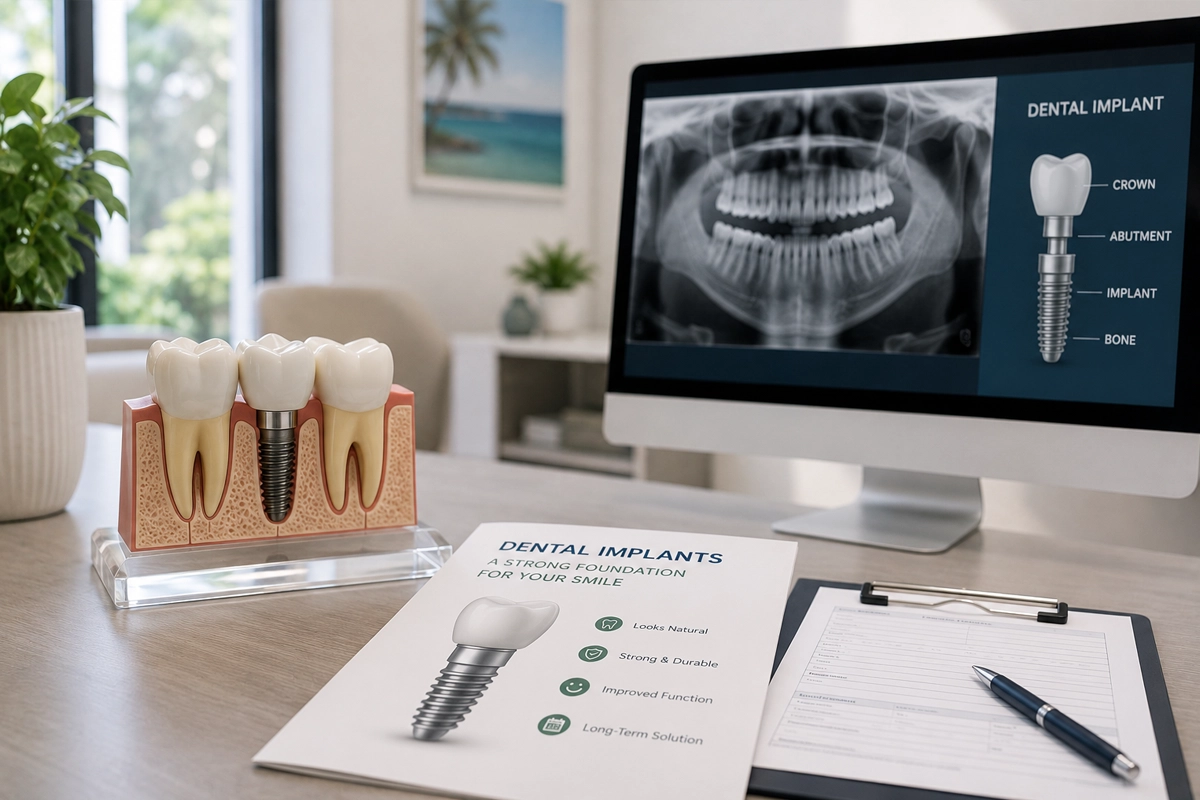
Dental Implants
Dental Implants: What Patients Should Know
Learn what dental implants are, how they may help replace missing teeth, what to expect during the process, and what questions to ask your dentist.
Our team is here to help you understand your options. Nuestro equipo está aquí para ayudarle a entender sus opciones.
Call Gateway Dental to schedule a visit or ask questions about services, insurance, financing, or next steps. Llame a Gateway Dental para agendar una visita o hacer preguntas sobre servicios, seguros, financiamiento o próximos pasos.